Entry · Ref ZS4EG1NJ
Why Professional Tree Felling Matters for Safety and Property Protection
- Posted
- 2026-10-09
- Last amended
- 2026-10-09
- Account
- @theprofessionaltreefellingnews
Understanding the Risks of Tree Removal
When a large tree on your property becomes a hazard or needs to come down for construction or landscaping reasons, the first thought might be to grab a chainsaw and handle it yourself. After all, how hard can it be to cut down a tree? The reality is that tree felling is one of the most dangerous jobs in the green industry. Without proper training, the risk of injury, property damage, and even death is high. That is why professional tree felling is not just a service but a critical safety measure for homeowners and businesses alike.
In Cape Town, where the combination of strong coastal winds and mature trees is common, the stakes are even higher. A tree that looks stable from the ground may have hidden decay, a leaning trunk, or compromised roots. A tree surgeon or certified arborist can spot these issues during a tree risk assessment before any cutting begins. This upfront evaluation often saves money and prevents accidents, especially when the tree is close to a building, power line, or public walkway.
What Professional Tree Felling Actually Involves
Professional tree felling is a systematic process that starts long before the first cut. First, a trained arborist will visit your property to conduct a tree risk assessment. They will measure the tree height, evaluate its lean, check for dead branches, and look at the surrounding area. This is when a professional quote is prepared, based on tree size classification, species identification, site access, and the complexity of the job. Pricing is not one-size-fits-all; a small, accessible tree in an open yard costs far less than a large, leaning tree overhanging a house or a narrow driveway.
Once the plan is finalised, the work begins. Directional felling is the standard technique used to control exactly where the tree will fall. By cutting a notch on the side where you want the tree to go and leaving a hinge of wood on the opposite side, the arborist guides the tree into a predetermined fall zone. This is not guesswork. It involves precise chainsaw cuts and a deep understanding of timber physics. For trees that cannot be felled in one piece due to obstacles like fences, roofs, or garden beds, the team may use a crane-assisted felling method. This involves rigging cables and lifting sections of the tree away under controlled tension.
Why You Need a Tree Removal Permit
Many homeowners do not realise that cutting down a tree in Cape Town often requires a tree removal permit from the local municipality. Regulations vary by suburb and depend on the tree species, size, and whether the tree is listed as protected. Ignoring this step can lead to fines or legal trouble. A reputable tree service will handle the permit application on your behalf, ensuring full compliance with local municipality regulations. This is another reason to choose professional tree felling over a DIY approach. The paperwork alone is enough to make most people reconsider.
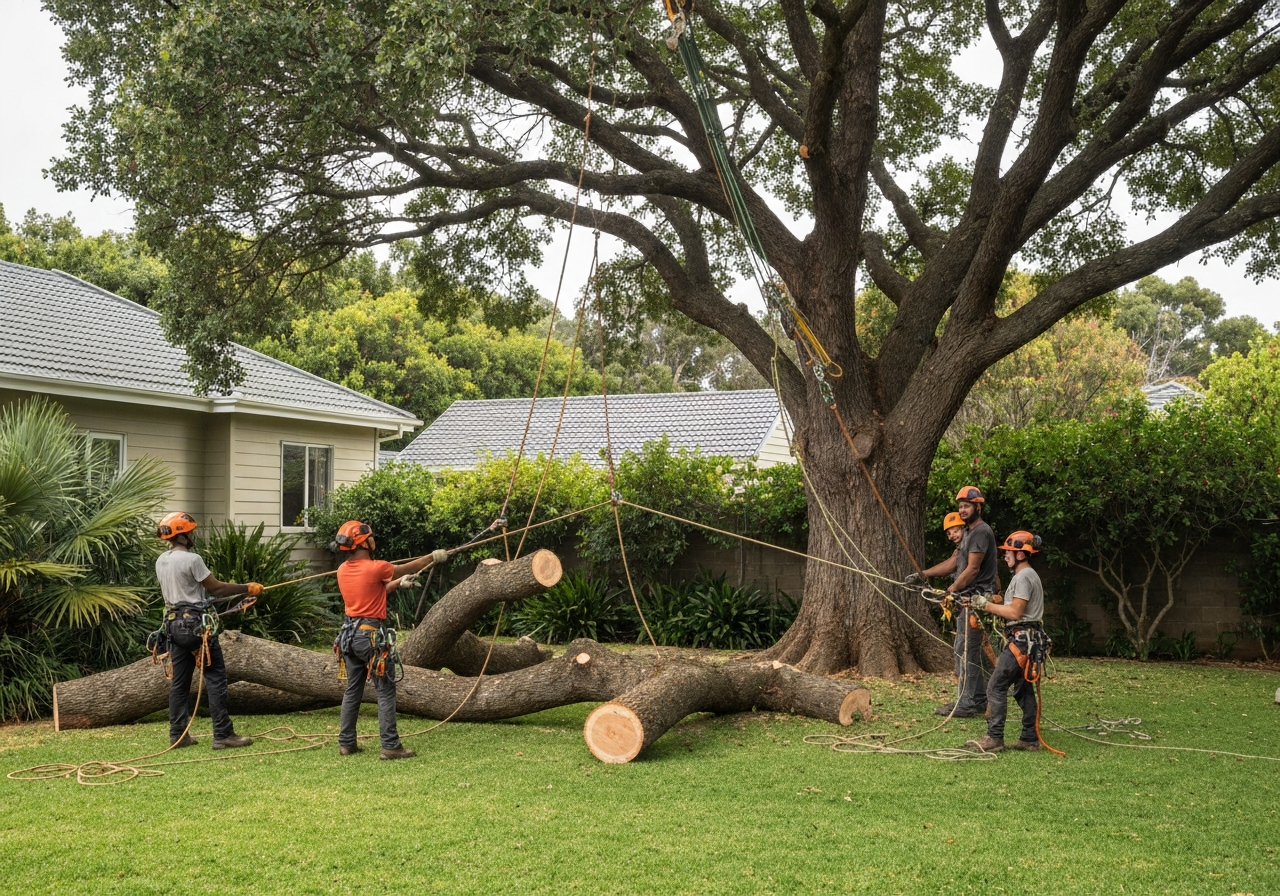
Even if a tree is clearly dead or dangerous, the permit process still applies in many cases. The municipality may want to inspect the tree first, especially if it is a protected species like an oak or a yellowwood. Having a certified arborist on your side speeds up the process, because their tree risk assessment is accepted by most local authorities as a valid basis for removal.
The Hidden Costs of DIY Tree Removal
On the surface, renting a chainsaw and doing the job yourself seems cheaper. But the hidden costs are significant. If the tree falls the wrong way and damages your roof, a fence, or a neighbour’s property, you are looking at thousands of rands in repairs. If it hits a power line, the risk of electrocution is real, and the utility company may charge for emergency callouts. Then there is the cleanup. A large tree can produce tonnes of branches, leaves, and logs. Removing that tree debris from your property is hard physical work, and if you do not have the right equipment like a stump grinder, you are left with an ugly stump that can attract termites and become a tripping hazard.
Professional tree felling includes stump grinding and full cleanup as standard. The stump grinder is a powerful machine that chews the stump down to below ground level, allowing you to plant grass or a new tree in the same spot. The team also hauls away all the branches and logs, leaving your yard tidy. When you factor in the cost of hiring a stump grinder, renting a chipper, and paying for waste disposal, the DIY savings vanish. And that is assuming you do not hurt yourself. Chainsaw injuries are among the most severe in the landscaping trade, often requiring stitches or surgery. Your health insurance may not cover accidents caused by reckless behaviour.
When to Call a Professional
Not every tree needs a full removal. Sometimes a simple pruning or thinning is enough to reduce the risk of limb failure. But if you notice any of the following signs, it is time to schedule a professional quote:
- The tree has a large lean toward your house or a busy street.
- There are dead branches, cracks in the trunk, or fungal growth at the base.
- The tree has been struck by lightning or damaged in a storm.
- Roots are lifting your driveway, foundation, or underground pipes.
- The tree is interfering with power line clearance and needs to be removed completely.
An arborist will use tree height measurement and species identification to determine the best course of action. For example, a fast-growing gum tree has different structural weaknesses than a slow-growing oak. A tree surgeon trained in local conditions knows which species are prone to failure and how to manage them safely.
The Role of Crane-Assisted Felling in Tight Spaces
One of the most impressive techniques used by professional tree felling crews is crane-assisted felling. This is reserved for the trickiest jobs where directional felling alone is not enough. The crane lifts sections of the tree as the arborist cuts them, lowering each piece carefully to the ground. This eliminates the risk of the tree falling onto a house, a swimming pool, or a protected garden. It also reduces the size of the fall zone, which is critical on small properties in dense suburbs like Vredehoek or Constantia. Crane work is expensive, but it is often the only safe way to remove a tree that is surrounded by obstacles. The cost is reflected in the professional quote, but so is the peace of mind that comes from knowing your property is protected.
After the Tree Is Down: Stump Grinding and Cleanup
Once the tree is felled, the job is not finished. The stump remains, and if left untreated, it can sprout new growth or become a home for ants and beetles. Stump grinding is the most effective solution. The stump grinder is a heavy machine with a rotating cutting disc that literally grinds the stump into wood chips. The depth of grinding can be adjusted, but most homeowners choose to go at least 20 centimetres below ground level so the area can be covered with soil. The resulting wood chips can be used as mulch in your garden or hauled away as part of the tree debris cleanup service. Full cleanup also means raking up smaller branches, leaves, and sawdust so that your property looks the same as it did before the tree came down, minus the tree itself.
Property Damage Prevention Starts with Planning
Every experienced arborist will tell you that property damage prevention is the top priority. This starts with a detailed site access evaluation. If the tree service cannot get their equipment close to the tree, the job becomes more labour-intensive and therefore more expensive. Narrow gates, steep slopes, and soft ground all affect the approach. During the tree risk assessment, the arborist will walk the entire property, checking for underground cables, irrigation lines, and other hidden hazards. They will also discuss the fall zone with you, explaining exactly where the tree or its sections will land. If there is any doubt about safety, they will recommend crane-assisted felling or manual rigging with ropes and pulleys. This level of care is what separates a professional job from a backyard attempt.
In the end, professional tree felling is an investment in safety, legality, and property value. Whether you need a single tree removed from a tight space in Cape Town’s southern suburbs or a large eucalyptus on a windy slope, hiring a qualified team with the right equipment and local knowledge is the only sensible choice. They bring the chainsaw, the stump grinder, the permits, and the experience. You bring the peace of mind.